
Portrait of Matthieu Queloz

Matthieu Queloz

Welcome

I am an Ambizione Fellow at the University of Bern and incoming Swiss National Science Foundation Professor at the University of Zurich. The thread running through my work is conceptual change: how our concepts arise and evolve, what makes some ways of thinking better than others, and how our thought and talk must adapt to the advent of cognitive systems whose forms of understanding differ radically from our own. I pursue these questions both as a historian of philosophy and as a philosopher of mind and language. Historically, I have reconstructed how early modern philosophers from Ramus and Keckermann to Leibniz and Kant came to make thought systematic, and how Hume and Nietzsche, Wittgenstein, and Williams explained the emergence and evolution of our concepts and norms by tracing them to the needs they serve. Systematically, I have developed an account of how concepts can be evaluated, engineered, and adapted to our needs, and I now lead a five-year project on concepts, understanding, and normativity in large language models: which forms of understanding and world models emerge in neural networks, how far they can reproduce normative judgement, and how far our concepts of understanding and reasoning can be stretched to fit them. The two strands meet in the wheel above: Llullian concept wheels inspired Leibniz’s calculus of concepts, which in turn inspired McCulloch and Pitts’s artificial neural networks. I see the emerging field of mechanistic interpretability as continuous with the early modern project of mechanistically reverse-engineering cognition, and I seek to develop insights from the philosophical tradition through interpretability work of my own. I am a member of the Digital Society Initiative and a founder of the Philosophy with Mechanistic Interpretability Network.

I have published three books with Oxford University Press, and my articles have appeared in Mind, Philosophy and Phenomenological Research, Philosophical Studies, Philosophers' Imprint, The Philosophical Quarterly, European Journal of Philosophy, The Monist, Archiv für Geschichte der Philosophie, British Journal for the History of Philosophy, Synthese, Analysis, The Journal of Political Philosophy, Minds and Machines, and Philosophy & Technology. In 2022, I received the Amerbach Prize of the University of Basel and the Lauener Prize for Up-and-Coming Philosophers.

I have organized my articles by whether they would be most of interest to someone coming from the theoretical, practical, or historical side of philosophy. To facilitate navigation by themes, I also built a system of tags and a search interface. The full site is available in English, French, or German. My last name is pronounced with a silent ‘z’ [ ˈkəloː ]. To contact me, you can send me an email. To be notified of new publications, follow me on Google Scholar.

Books

The Ethics of Conceptualization cover
PDF

The Ethics of Conceptualization

Tailoring Thought and Language to Need

Oxford University Press, 2025 Open Access

Why should we accept one definition rather than another? The book develops a framework for judging concepts by the conceptual needs we uncover when we step back from them. It argues that sometimes, vague and even conflicting concepts are exactly what we need, and shows how to distinguish helpful clarification from conceptual gerrymandering.

Subject of the Bielefeld Masterclass in Philosophy 2024.

Cited as evidence before the UK Parliament (written evidence FDO0024).

“What are the grounds on which we should select the best concepts to use in representing our world and our psychology, in framing our ethical and political ideals? Queloz offers an incisive and comprehensive exploration of how this issue has been, and ought to be, answered ... a major contribution to a growing research program.” — Philip Pettit

“One of the most sophisticated and subtle book-length works … to come out within the last decade ... takes a step back and re-plots the logical terrain of its subject from a new perspective … also displays an incredible depth of knowledge across a wide variety of fields.” — Jennifer Nado

“An impressive and carefully articulated framework ... that bridges the more analytically oriented aspects of Queloz’s project with continental and pragmatist concerns. This existential dimension ... is part of what makes Queloz’s book so compelling” — Céline Henne, Yvonne Huetter-Almerigi, and Matteo Santarelli, Analysis

“The most developed account to date” — Sebastian Köhler and Herman Veluwenkamp, Synthese

“Insightful, clear, and impressively well-crafted ... philosophically ambitious and relevant to a wide range of contemporary debates” — Stefan Fischer, Canadian Journal of Philosophy
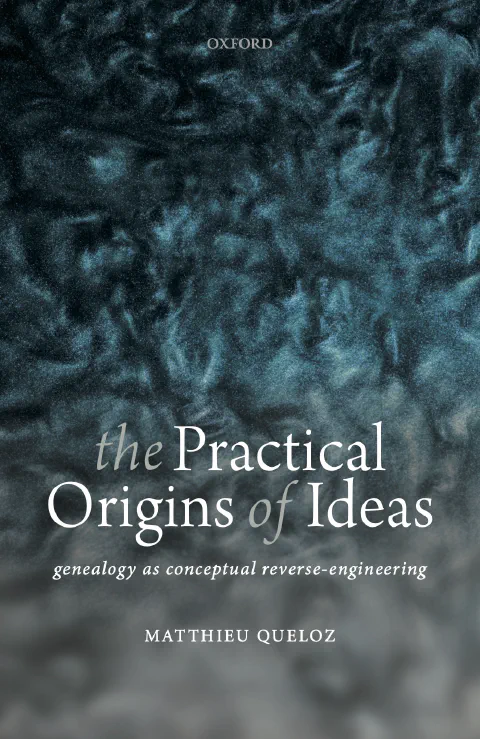
The Practical Origins of Ideas cover
PDF

The Practical Origins of Ideas

Genealogy as Conceptual Reverse-Engineering

Oxford University Press, 2021 Open Access

A study of the “state-of-nature” stories and genealogies that explain why abstract ideas arise in the first place. The book traces this practice from Hume, Rousseau, and Nietzsche to E.J. Craig, Bernard Williams, and Miranda Fricker, showing how genealogy can reverse‑engineer the pressures that make concepts worth having. The book was translated into Arabic and Japanese.

“Superb ... [a] splendid book” — Cheryl Misak, Analysis

“Excellent” — Huw Price, Cambridge Core

“Refreshingly ambitious … delightful to read: the prose is colorful, elegant, and sharp, and Queloz has a knack for bringing high-minded ideals down to earth. I wish more philosophers wrote so well.” — Michael Hannon, Mind

“Ground-breaking” — Paul Roth, Analysis

“There is a tremendous amount to be learned from this very stimulating book” — Peter Kail, Notre Dame Philosophical Reviews

“Clear, impressively erudite, well-structured, sensitive to both historical and systematic questions about genealogy … an invaluable contribution” — Christos Kyriacou, Journal of Value Inquiry

Bernard Williams on Philosophy and History cover
PDF

Bernard Williams on Philosophy and History

Edited by Marcel van Ackeren & Matthieu Queloz

Oxford University Press, 2025

For Bernard Williams, philosophy and history are deeply connected. He argues that philosophy, unlike science, cannot ignore its own history, and that historical engagement, whether to produce history or philosophy, requires acknowledging the past's difference from the present. Furthermore, systematic philosophy itself requires a historical approach to its concepts. This volume explores these different interconnections through commissioned contributions that critically appraise Williams’s work in the history of philosophy, his historicist turn, and his use of genealogy. The collection uniquely combines substantive discussions of historical figures (from Homer to Wittgenstein) with methodological discussions of how philosophy should use and engage with history.